Cody Daysail Leader and Skipper – Detailed Guidance Document
Summary of this guidance – two sides of A4 for laminating
This document describes in detail the roles and responsibilities of the Daysail Leader for a Cody Sailing Club event. It supports the summary presented in the Daysail Leader Checklist. Headings and text in italics are taken from the Checklist and elaborated upon in this document
It is good practice to have a lead daysail leader and a deputy daysail leader if there are enough suitably experienced sailors on the sail. The deputy can manage the back of the fleet while the primary daysail leader leads from the front, and if there is a need for some of the fleet to return early each part of the fleet has a daysail leader. Best practice is that both have a VHF radio and can communicate their thoughts as the dynamic risk assessment is carried out.
The Daysail leader’s responsibilities begin well in advance of the sailing event itself and continue throughout the day and until after the sailing event has finished. Timescales are suggested for the advanced preparation activities, although the Daysail Leader will need to be pragmatic and flexible in applying these to any given event.
The guidance offered in this document is based on Cody SC and individual member experiences, supported by wider ‘best practice’ from other external sources e.g. the RYA.
Preparation: The Week Before
Notice & Communication
Send out the initial “calling notice” with an initial plan. Maintain contact with all participants throughout the week. Understand which boats will be attending to allow those bringing boats time to prepare and to report any issues for example, if they are no longer able to tow a boat.
At least 1 week before the event, send out the “calling notice” with an initial plan for the event. This should be sent via e-mail to all club members using the Club email address (crew@…) and a brief summary should also be posted on the Club WhatsApp group, with the aim of making sure everyone is aware of the event. You should be aware of the following information regarding the event (from the published events list), which should be included as a minimum:
- Date
- Launch location
- Sailing objective
- Time of High Water at sailing location, which is included in the programme of events on the club website or available online e.g. Easytide
- Additional information concerning the event may be added if known to help ‘sell’ the event, e.g. things to see, sailing challenges, previous years’ highlights etc.
Note:- The email should ask for the names and other information as listed on the Attending a Fleet Dinghy Cruise page.
For anyone wishing to participate, a deadline should be set for responses. Approx. 36 hours prior to the event is suggested but this should be driven by the Daysail Leader’s availability and their planning needs. Whilst the Daysail Leader should try and be accommodating to last-minute changes, members will need to recognise that this will not always be possible.
As the deadline approaches, the Daysail Leader should make a provisional assessment of how many club boats are required, and consider Skippers, crews and towing arrangements. Skippers should hold at least RYA Seamanship Skills qualification or corresponding experience and competence. Check with the Bosun or the Booking Secretary (currently the Rear Commodore) that the club boats required are available (NB. Dinghy Section cruises take priority over private bookings).
Check that the cruise is suitable for inexperienced sailors or children, taking into account the number of boat spaces, duration and the likely conditions (a general weather forecast will be available at this stage). Consider any potential changes to crewing arrangements and discuss with those affected e.g. where an inexperienced sailor may benefit from sailing with a more experienced one.
Consider whether engines are likely to be required. Or any other equipment that may not be considered ‘standard’ for all the boats attending (e.g. anchors, reefable mainsail, towing ropes, radios, etc.). It is reasonable for the Daysail Leader to expect members’ personal boats to be suitably equipped for coastal cruising, but prudent to confirm with skippers.
The Daysail Leader should decide on one or more land rendezvous locations. As a minimum this will be the launch location, but may also include e.g. Frensham to collect club boats. Members may also elect to lift-share to reduce the number of cars travelling. The Daysail Leader does not necessarily need to coordinate this. The rendezvous at the launch location should be early enough to allow ample time for boat rigging prior to departure. This is likely to need to be at least 1 hour before launch. The Daysail Leader should tell participants the intended launch time, with the expectation that they arrive early enough to rig their boat.
Conditions Check
Study the day-by-day weather forecasts (assessing confidence), tides, and the impact of large ship movements or other fleets (e.g., races)
Weather planning. Start monitoring the weather forecast from a few days prior to an event, using multiple sources. It is a Club requirement that the cruise shall not, in general, take place if there is a force 6 or above in the official Shipping Forecast or Inshore Waters forecast as relevant to the sailing area in question, for the period of the cruise.
- The shipping and inshore waters forecast are the ones issued by the Met Office, on behalf of the Maritime and Coastguard Agency. They are available from their website.
- Note that the coverage extent for the inshore forecast is up to 12 miles offshore; CSC cruises will generally remain well within this boundary.
Consider the desirability of using the planned launch venue (e.g. will it be an exposed lee shore in a fresh wind?). It may be more prudent to opt for a harbour cruise or a beach day rather than a cruise on open water. If marginal (see examples below), plan such an activity as a fallback option. If the conditions are marginal, but you still consider them acceptable for a cruise, then make plans for alternative objectives and/or diversion landing sites or refuges that are sheltered from the sea and wind. In fresh winds, try to avoid a long beat to windward, even if this means that the original plan has to be modified.
If the best available information on the evening prior to the event suggests that the wind strength for the cruise will clearly be force 6 or above, the cruise should be cancelled and participants informed. If inland wind strengths are acceptable, and there is interest from the participants, a non-coastal sailing activity (e.g. at a reservoir) could be considered.
If the forecast wind conditions are marginal the event can be put on standby, with the final decision being taken in the morning, based on the early morning inshore and shipping forecasts.
The table below gives some examples of marginal wind forecasts. In such cases consult as many additional sources of weather information as possible to establish a more complete picture of the wind (e.g. local area forecasts, local radio inshore forecasts and the many on-line services such as Wind Guru, XC Weather, Windy and Windfinder). Be sure to consult maritime forecasts i.e. shipping forecast and inshore waters forecast, for the planned sailing area and adjacent ones (notably up-wind). Consult with other club members if required.
Take caution and consider switching to your fall-back options such as a beach day or harbour cruise. Less experienced Daysail Leaders should consult an experienced Daysail Leader, along with the experience of those attending. Give particular consideration to the levels of experience and physical fitness amongst the participants. Do not decide to set off for the coast unless you are confident that conditions will at least be suitable for your fallback option.
| Example marginal wind forecasts (based on the early morning inshore & shipping forecasts on the day of the event) |
| The inshore forecast is no higher than force 5, but there is a force 6 in the shipping forecast. The risk is that the F6 comes inshore. |
| The inshore forecast indicates a force 6 but not in the immediate sailing area (e.g., for Solent sailing, Selsey Bill to Lyme Regis forecast indicates ‘occasional force 6 in the West’). The risk is that the F6 moves into the proposed sailing area. |
| The inshore forecast is indicating ‘force 6 decreasing …..’(Try get an understanding of when the wind is likely to decrease. If you go, assess the conditions on arrival and be prepared to delay sailing until the wind has subsided). The risk is that the wind does not drop, which is OK as long as you don’t go sailing while it’s too windy. |
| The inshore forecast is indicating force 5 but ‘increasing force 6 later’ (later means more than 12 hrs from time of issue) (Do not commence a long cruise. Consider beach day with earlier start and be prepared to finish early). The risk is that the F6 will arrive early. |
| The inshore forecast is indicating ‘occasional force 6’ but other sources indicate lower wind strengths. (Do not proceed with a cruise. A beach day may be considered – brief crews to watch out for squalls and be ready to come ashore until they pass). The risk is that the fleet may be hit by an unexpected F6. |
| Visibility While wind strength and direction is very important when deciding to conduct fleet dinghy cruising, visibility is also critical to this kind of sailing. If there is fog, mist or a “warm sector” with drizzle and low cloud likely to impact visibility, also consider cancelling or making a sail a beach day. |
No wind is just as unhelpful as too much wind, and do cancel a sail if there is no wind in the forecast.

Route & Safety
Plan the route in detail, including rendezvous points and refuge locations. Send the plan to experienced daysail leaders for validation.
Passage Planning
Plan navigation and timings. Plan the event’s navigation and timing in advance. Review and be prepared to adapt the plan when participating boats and crew are confirmed and again prior to taking to the water. The guidance offered below should be followed throughout the planning process and during the sailing event. Take into account the considerations below. Make appropriate allowance in your planning for inexperienced crews or helmsmen.
Passage planning is a bit of an art, and using existing passages can be very helpful. If you are planning a new-to-you sail, see if there are records of previous sails to that same location. See existing dinghy passage planning or use an RYA Dinghy Trail for inspiration. Use https://gb.mapometer.com to find the distance.
A 14ft dinghy will sail at a maximum displacement speed of about 5 knots, and when sailing upwind will achieve about 0.6 times maximum displacement speed, so about 3 nautical mph. Therefore a 10 mile upwind sail will take about 2.5 hours, and that’s generally enough sailing in one leg. If boats achieve planing speed the average speed is much higher, but do not rely on planing to complete the cruise. A good daysail is 10 miles, and extreme daysail is 20 miles.
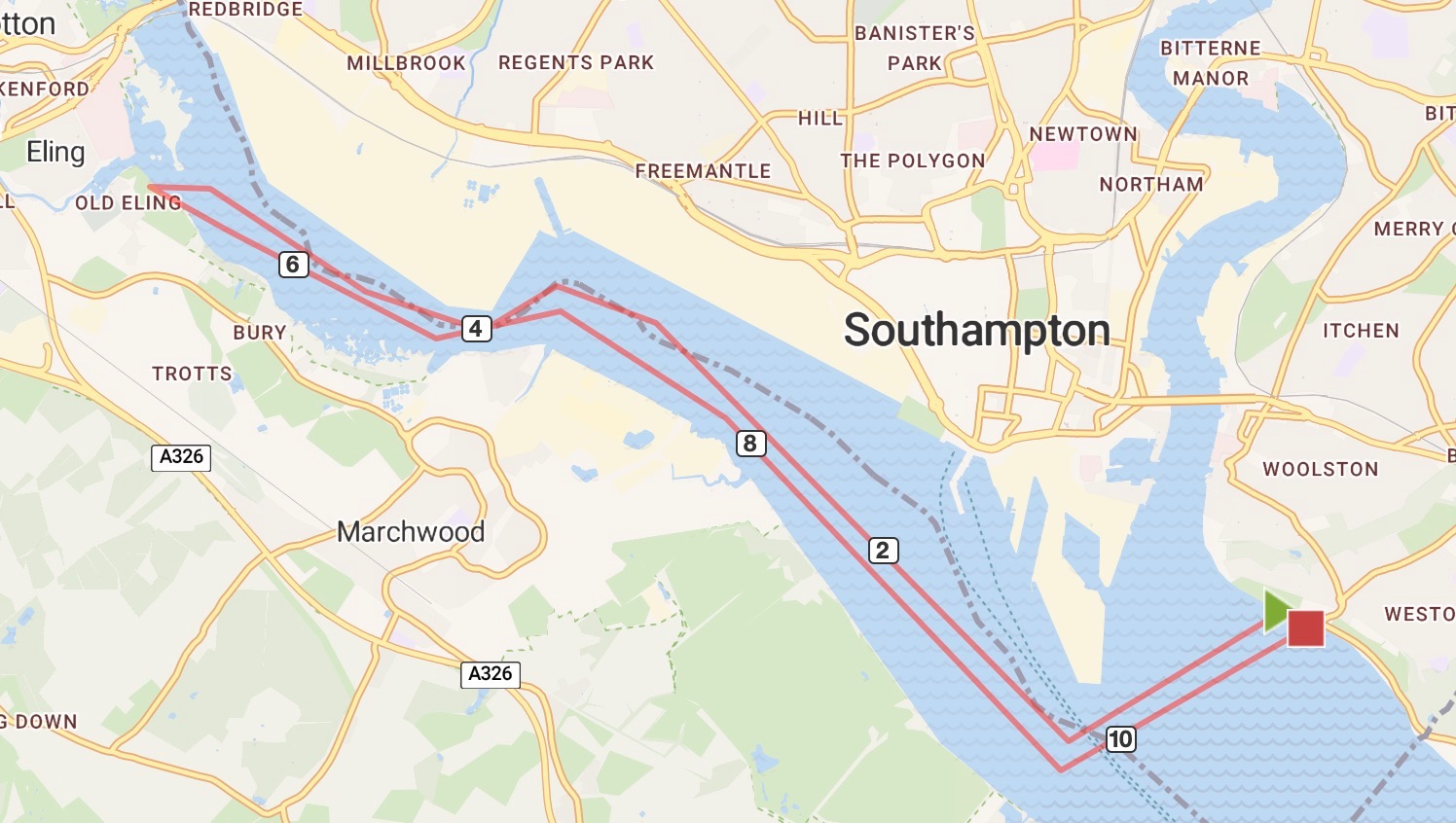
An example of a 10 mile daysail is Southampton SC to Eling, which is just short of 11 miles. A pleasant daysail where the wind can be F3-5.
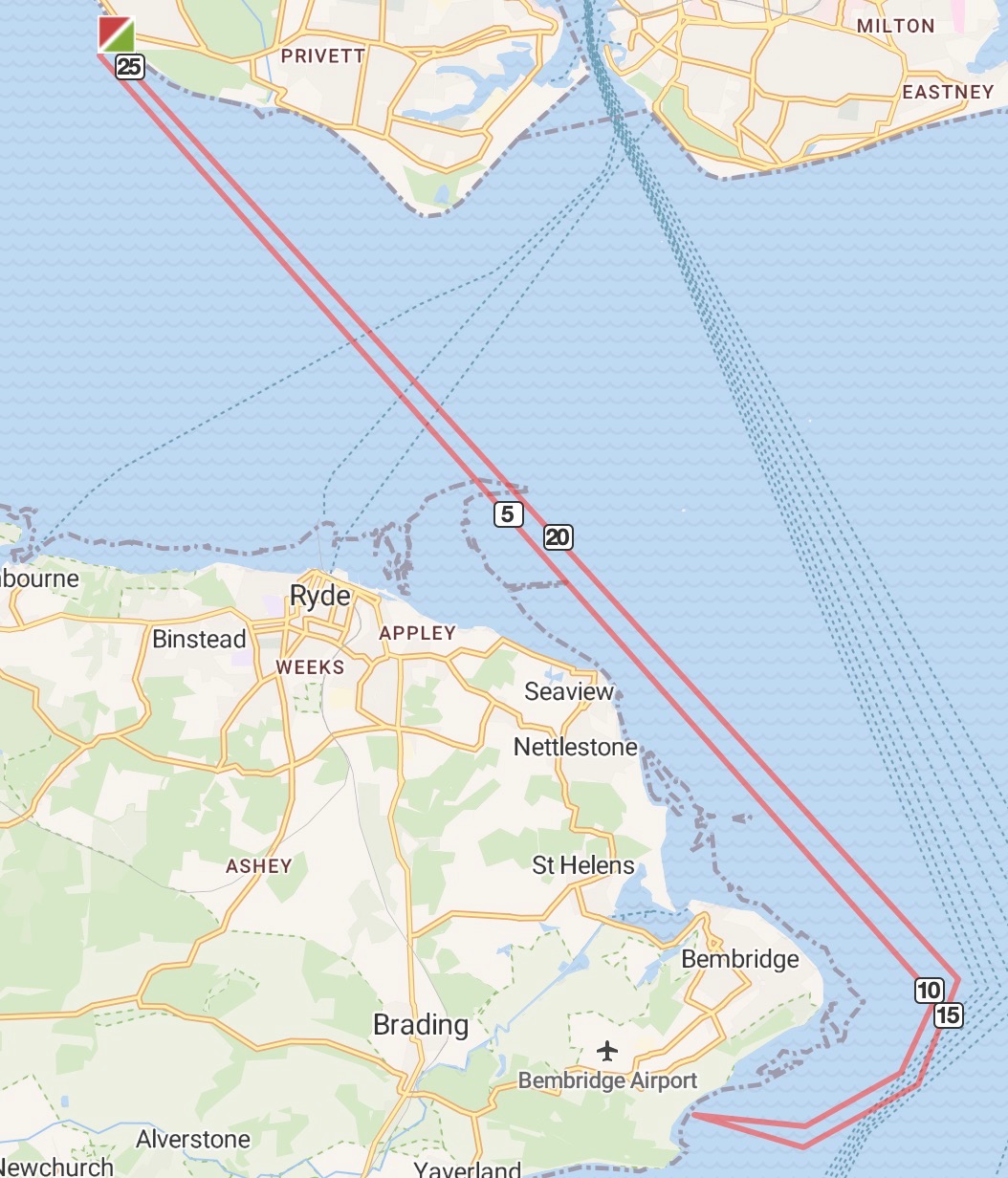
Whereas one of our most ambitious daysails is from Elmore Car Park to Whitecliffe Bay which needs a F4 to F5, plus a specific tide to complete.
Use https://gb.mapometer.com/ to roughly assess how far a dinghy cruise will be without taking into account the 0.6 factor for a beat. Remember to untick “Follow Roads”.
Aim to plan for a sail upwind and with the tide on the way out, and downwind and with the tide on the return leg, and remember that upwind with the tide is a wind-against-tide leg and will have steeper waves and be much wetter. Many of the daysails already planned are with the expectation of a South to South-West to West prevailing wind, so be prepared to change the destination if the wind is coming from elsewhere.
Having a destination with public toilets is very important so that attendees can manage biological needs, and if the destination itself has no convenience, ensure that there is a stop before or after the lunchtime stop with a public toilet if possible.
Additional considerations for daysail planning.
Plan navigation and timings
Plan the event’s navigation and timing in advance. Take into account the considerations below. Make appropriate allowance in your planning for inexperienced crews or helmsmen. The considerations detailed below should be part of the planning process and must be reviewed as part of the dynamic risk assessment on the day.
Risk Management
Gather information about the risks
Will the crews shared medical or fitness concerns with their skipper?
Will the skippers shared their concerns about themselves and their crew confidentially with the daysail leader?
Will the skippers of the boats involved considered their ability, the health of themselves and their crew given the conditions forecast and the intended destination?
Risk Treatment: Elimination of risk
Should the cruise go ahead at all?
Does the fleet of dinghies, and the health and capability of the crews suit the conditions and the planned destination?
Can all vessels be reefed afloat? If not, is the dinghy suitable for this cruise?
Are the crews experienced enough to handle the sailing, and an incident such as a capsize
Call the cruise off if there is insufficient experience and fitness, or the boats are not suitable for that cruise.
Risk Treatment: Substitution of risk
Should the cruise go to the destination that has been advertised and planned? What closer or easier destination could be considered?
Can the crews be re-allocated amongst the fleet to strengthen the fleet overall?
Can crews be reallocated to three to a boat with not so many boats being used?
Should the cruise be shortened to a destination more aligned with the available crew’s fitness and abilities?
Given the conditions of the day, have the skippers and crew of the boats involved identified that their boats were able to be reefed ashore and afloat? If not, they must liaise with the Day Sail Leader to either effect a different plan and destination or agreed crewing with the other boats that do have full reefing capabilities.
Use of engines and towing.
Consider whether engines need to be taken, and which boats will tow and who will be towed should this become necessary.
Permissions and payments
Identify and contact all necessary authorities for information or permissions.
This may include the landowner at the launch location, beach or slipway, the Harbour Master, port authority or other. Seek advice from other Club members and/or online if required.
Ensure that you know and can brief how launching and sailing fees will be paid.
Final Confirmation & Cancellation
Cancellation Check
Re-check the weather. Cancel as early as possible if conditions are unsuitable.
In the run up to the event the Daysail Leader will need to make a judgement about any need to cancel. Where weather conditions are clearly unsuitable an early no-go decision should be communicated with participants (ideally 48 hours in advance if possible). In more marginal conditions this decision may need to be nearer the time, keeping participating members informed as possible.
Final Plan
Confirm the plan, boats, crews and cancellation criteria with all participants.
No later than the night before the event, let everyone know the arrangements and travel details:-
- Confirm that those towing club boats are competent to do so and have planned to collect the appropriate club trailers (plus associated straps, lighting boards and spare wheel) usually stored in the boats at Frensham Pond. Confirm that anyone collecting boats from Frensham knows the gate lock code and any FPSC specifics e.g. parking permit if leaving a car there.
- Confirm if they are taking a club engine and associated fuel can and oil, and have planned to buy fuel, and mix oil, if necessary. Note that Cody SC uses Aspen 4 stroke fuel and mixes marine specific 2 stroke oil (TC-W3) at 50:1 to minimise environmental impact. Aspen 2 stroke does not contain marine specific oil and should not be used in a marine environment.
- If the weather forecast suggests that conditions could be marginal or the launch venue may need to be changed, warn participants that they may receive a last minute message from the Daysail Leader..
- Ensure everyone is aware of the need for appropriate clothing (e.g. foul weather clothing, soft shoes), safety aids, sun screen and food/drink as necessary.
- It is not essential to decide in advance the travel arrangements from Frensham to the launch site but it may be of benefit to consider the route and cars / drivers.
- Check with the drivers to see if they wish to travel in convoy. Ideally ensure skipper and their associated crew travel in the same car and tow their allocated boat.
- Remind club boat Skippers to ensure that, before leaving Frensham, they have the following items for their boat:- watertight canister containing flares, spares and first aid kit, anchor, a bailing device and oars/rowlocks and/or paddles.
Go/No-Go
Perform the final check against cancellation criteria. Send “go” or “cancel” notice.
By 6am on the day of the sailing event the Daysail Leader should perform a final check against the cancellation criteria. This doesn’t preclude a later decision not to take to the water, or to change sailing plans once afloat.
- Should this sail still go ahead?
- Should the crewing arrangement change to ensure safety and viability?
- Is the planned duration and destination appropriate, or should a closer objective be selected?
- Should all boats participate? Which boats to leave behind?
The decision should be communicated to participants as soon as possible.
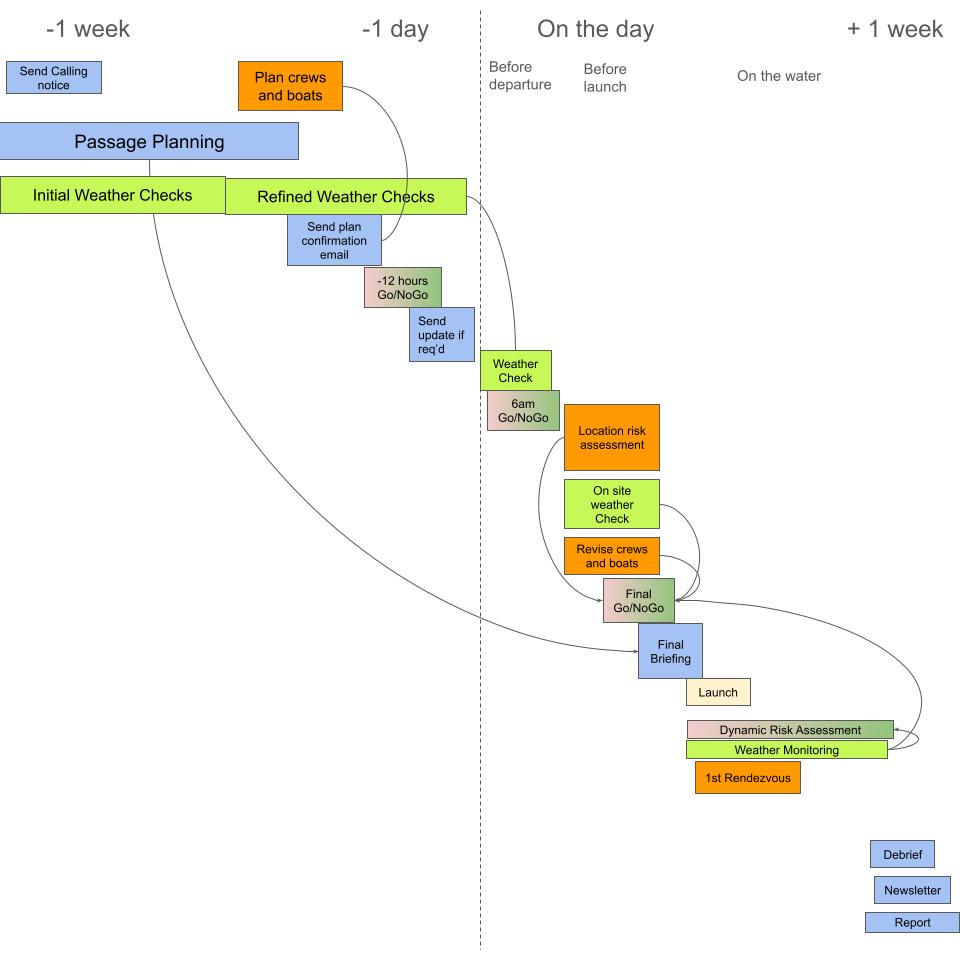
Visual Summary